Alessandro Oppo: Technology
Download transcript (.srt)
0:00
0:01
0:04
0:07
0:10
0:11
0:13
0:14
0:18
0:19
0:22
0:30
0:33
0:36
0:39
0:44
0:49
0:51
0:55
0:57
1:02
1:04
1:07
1:09
1:12
1:14
1:16
1:18
1:20
1:21
1:23
1:25
1:30
1:33
1:37
1:38
1:40
1:42
1:45
1:48
1:51
1:56
2:01
2:09
2:16
2:18
2:24
2:29
2:30
2:34
2:36
2:43
2:45
2:46
2:49
2:51
2:54
2:56
2:59
3:03
3:06
3:08
3:10
3:11
3:13
3:19
3:20
3:28
3:30
3:32
3:34
3:36
3:42
3:44
3:45
3:52
3:56
3:59
4:01
4:02
4:04
4:12
4:13
4:22
4:23
4:26
4:29
4:31
4:33
4:34
4:37
4:39
4:43
4:49
4:52
4:54
4:58
4:59
5:02
5:06
5:09
5:12
5:15
5:18
5:19
5:21
5:23
5:24
5:29
5:30
5:34
5:36
5:37
5:38
5:45
5:50
5:51
5:54
5:55
5:59
6:07
6:09
6:12
6:21
6:25
6:27
6:30
6:33
6:36
6:44
6:46
6:51
6:52
6:55
6:58
7:00
7:01
7:05
7:10
7:12
7:14
7:17
7:25
7:28
7:29
7:32
7:37
7:39
7:41
7:43
7:44
7:51
7:53
7:56
8:03
8:07
8:08
8:13
8:15
8:21
8:23
8:27
8:31
8:40
8:42
8:48
8:52
8:54
8:56
8:57
9:00
9:02
9:05
9:07
9:11
9:12
9:15
9:17
9:18
9:27
9:32
9:33
9:43
9:46
9:48
9:53
9:57
9:59
10:00
10:02
10:04
10:06
10:08
10:13
10:15
10:17
10:20
10:23
10:25
10:30
10:33
10:37
10:39
10:42
10:45
10:46
10:49
10:51
10:57
11:07
11:12
11:19
11:20
11:22
11:25
11:27
11:34
11:37
11:40
11:42
11:46
11:49
11:52
11:55
12:00
12:03
12:05
12:07
12:10
12:12
12:17
12:19
12:21
12:24
12:31
12:33
12:40
12:43
12:46
12:47
12:54
13:00
13:04
13:06
13:08
13:10
13:14
13:15
13:16
13:20
13:27
13:30
13:32
13:35
13:38
13:39
13:46
13:46
13:49
13:50
13:51
13:53
13:59
14:03
14:05
14:10
14:12
14:14
14:15
14:17
14:18
14:22
14:23
14:28
14:29
14:31
14:33
14:34
14:36
14:38
14:39
14:44
14:45
14:47
14:49
14:54
14:56
15:03
15:06
15:07
15:15
15:20
15:21
15:23
15:25
15:27
15:33
15:38
15:39
15:46
15:51
15:57
16:00
16:00
16:01
16:03
16:05
16:12
16:14
16:20
16:26
16:29
16:33
16:39
16:44
16:47
16:49
16:55
16:57
17:00
17:07
17:09
17:10
17:12
17:16
17:19
17:21
17:24
17:29
17:33
17:39
17:46
17:48
17:51
17:51
17:59
18:02
18:05
18:12
18:13
18:16
18:24
18:24
18:26
18:32
18:35
18:39
18:46
18:50
18:51
18:56
19:06
19:08
19:13
19:17
19:24
19:25
19:26
19:28
19:30
19:35
19:38
19:39
19:41
19:43
19:46
19:48
19:51
19:52
19:53
19:54
20:00
20:06
20:12
20:20
20:22
20:24
20:27
20:29
20:31
20:32
20:34
20:35
20:38
20:43
20:45
20:49
20:56
21:00
21:01
21:02
21:05
21:10
21:11
21:14
21:19
21:26
21:30
21:38
21:39
21:46
21:48
21:53
21:56
22:01
22:04
22:09
22:14
22:15
22:17
22:21
22:25
22:29
22:31
22:32
22:36
22:41
22:45
22:46
22:50
22:51
22:53
22:55
22:57
22:59
23:04
23:05
23:06
23:08
23:13
23:18
23:19
23:21
23:23
23:26
23:29
23:31
23:32
23:35
23:41
23:42
23:47
23:49
23:52
23:54
23:58
23:59
24:02
24:06
24:08
24:09
24:10
24:17
24:20
24:26
24:28
24:31
24:32
24:33
24:35
24:37
24:38
24:42
24:47
24:52
24:55
25:01
25:05
25:07
25:09
25:12
25:15
25:19
25:20
25:22
25:23
25:24
25:30
25:33
25:35
25:39
25:41
25:46
25:49
25:51
25:52
25:57
25:59
26:01
26:02
26:04
26:11
26:13
26:15
26:19
26:24
26:32
26:36
26:40
26:44
26:47
26:48
26:50
26:51
26:53
26:55
26:57
26:58
27:03
27:04
27:07
27:08
27:12
27:14
27:18
27:21
27:25
27:27
27:30
27:33
27:40
27:46
27:48
27:54
27:56
28:01
28:02
28:03
28:05
28:07
28:09
28:11
28:15
28:17
28:21
28:29
28:30
28:33
28:39
28:42
28:45
28:47
28:54
28:56
28:57
29:03
29:05
29:08
29:11
29:18
29:22
29:24
29:29
29:31
29:34
29:36
29:37
29:40
29:40
29:42
29:43
29:45
29:53
29:58
30:06
30:12
30:13
30:15
30:17
30:20
30:22
30:23
30:30
30:32
30:33
30:35
30:36
30:37
30:40
30:43
30:46
30:52
30:55
30:57
30:59
31:00
31:03
31:05
31:10
31:12
31:18
31:23
31:28
31:34
31:35
31:38
31:42
31:43
31:44
31:49
31:50
31:55
31:57
32:00
32:01
32:06
32:09
32:10
32:12
32:15
32:18
32:21
32:23
32:27
32:32
32:35
32:42
32:42
32:44
32:46
32:51
32:57
32:58
33:01
33:08
33:10
33:11
33:15
33:19
33:22
33:25
33:28
33:31
33:33
33:37
33:41
33:49
33:53
33:58
33:59
34:02
34:03
34:10
34:12
34:14
34:16
34:20
34:24
34:26
34:29
34:31
34:33
34:39
34:42
34:43
34:44
34:45
34:48
34:50
34:54
34:57
34:58
35:05
35:12
35:19
35:21
35:23
35:24
35:28
35:31
35:33
35:34
35:36
35:38
35:41
35:45
35:47
35:50
35:57
36:05
36:09
36:11
36:13
36:15
36:20
36:21
36:25
36:28
36:35
36:38
36:40
36:43
36:46
36:49
36:54
36:56
37:01
37:06
37:10
37:17
37:18
37:22
37:24
37:27
37:28
37:30
37:33
37:35
37:38
37:41
37:42
37:43
37:43
37:46
37:47
37:50
37:53
37:58
38:01
38:09
38:14
38:17
38:19
38:21
38:23
38:25
38:28
38:34
38:40
38:42
38:43
38:45
38:48
38:50
38:56
38:57
38:58
38:59
39:01
39:04
39:06
39:10
39:11
39:16
39:18
39:23
39:28
39:30
39:34
39:38
39:46
39:49
39:50
39:52
39:54
39:55
39:58
40:00
40:06
40:08
40:10
40:13
40:16
40:19
40:21
40:23
40:25
40:27
40:29
40:33
40:37
40:38
40:39
40:41
40:42
40:44
40:46
40:51
40:54
40:57
41:00
41:03
41:06
41:08
41:13
41:14
41:17
41:20
41:21
41:24
41:25
41:28
41:34
41:35
41:42
41:45
41:46
41:48
41:49
41:52
41:55
41:58
41:59
42:07
42:12
42:13
42:15
42:16
42:18
42:22
42:28
42:31
42:33
42:37
42:41
42:44
42:44
42:47
42:53
42:59
43:01
43:03
43:04
43:08
43:11
43:12
43:15
43:16
43:20
43:24
43:26
43:28
43:29
43:36
43:37
43:39
43:40
43:43
43:46
43:48
43:50
43:54
43:56
43:59
44:02
44:05
44:05
44:07
44:08
44:09
44:12
44:18
44:21
44:24
44:25
44:27
44:30
44:31
44:33
44:34
44:41
44:47
44:48
44:51
44:54
44:55
44:56
44:59
45:05
45:06
45:07
45:08
45:12
45:18
45:20
45:25
45:29
45:36
45:38
45:40
45:42
45:44
45:49
Alessandro Oppo: which tends to centralization
Alessandro Oppo: is never a good thing for democracy.
Alessandro Oppo: If the technology tends to to
Alessandro Oppo: be,
Alessandro Oppo: you know,
Alessandro Oppo: centralized,
Alessandro Oppo: and that is clearly the ambition of the developers of AI,
Alessandro Oppo: then
Alessandro Oppo: that we must insist on decentralization.
Paul Nemitz: Welcome to another episode of the Democracy Innovator podcast. My name is Alessandro Popp, and our guest of today is Paul Nimitz.
Paul Nemitz: Sorry for the pronunciation, and thank you for being here.
Alessandro Oppo: Thank you. And
Paul Nemitz: and, yeah, I have
Paul Nemitz: I mean, the first question is if you can tell us something about you
Paul Nemitz: because you work on many things, and so if you'd like to give us some
Alessandro Oppo: Sure. I'm a
Alessandro Oppo: visiting professor at the College of Europe in Brussels,
Alessandro Oppo: in in in Bruges,
Alessandro Oppo: in Belgium near Brussels, where I teach
Alessandro Oppo: a postgrad seminar
Alessandro Oppo: on AI law and
Alessandro Oppo: data protection law.
Alessandro Oppo: I do this as a retiree.
Alessandro Oppo: I was
Alessandro Oppo: director in the European Commission
Alessandro Oppo: for fundamental rights,
Alessandro Oppo: and citizen rights and special
Alessandro Oppo: adviser,
Alessandro Oppo: also principal adviser,
Alessandro Oppo: on the digital transition.
Alessandro Oppo: And in this context, I learned about the digital. I had my own playful
Alessandro Oppo: approach to the digital as a lawyer,
Alessandro Oppo: because I was the lead director on
Alessandro Oppo: the GDPR,
Alessandro Oppo: bringing GDPR
Alessandro Oppo: onto the law books.
Alessandro Oppo: I I led the whole conceptual preparation
Alessandro Oppo: and and the negotiations.
Alessandro Oppo: And, and that basically,
Alessandro Oppo: was such a learning experience that I stayed on
Alessandro Oppo: as, let's say, the principal adviser on on digital transition,
Alessandro Oppo: and all the following legal acts I I was also involved in, like the AI Act, the Data Act, and so
Alessandro Oppo: Not as a lead director. Only, the DGPR was, I was in the lead because my directorate general, DG Justice in the
European Commission was in the lead.
Alessandro Oppo: All the later acts giving shape to the digital sphere
Alessandro Oppo: were led by a different director general, namely
Alessandro Oppo: DG CONNECT,
Alessandro Oppo: which I would say is, let's say, the more engineering oriented director
Alessandro Oppo: general.
Paul Nemitz: And what is important to take into account when we talk about, digital trans transition or transformation?
Alessandro Oppo: Well, it is important,
Alessandro Oppo: that
Alessandro Oppo: the digital transition and also now,
Alessandro Oppo: the transition to a world
Alessandro Oppo: shaped by AI
Alessandro Oppo: does not lead
Alessandro Oppo: to a world where democracy
Alessandro Oppo: doesn't function anymore, where fundamental rights count for nothing.
Alessandro Oppo: I think we have to engage
Alessandro Oppo: and revive,
Alessandro Oppo: both fundamental rights
Alessandro Oppo: and,
Alessandro Oppo: democracy.
Alessandro Oppo: And, and I think that's that's a very, very important challenge because otherwise,
Alessandro Oppo: technology
Alessandro Oppo: and the companies behind the technology, they will just take over. They will rule us and our lives and our societies.
Paul Nemitz: Yeah. There is a lot of concentration
Paul Nemitz: of power
Paul Nemitz: among who,
Paul Nemitz: I mean, I'm thinking about the big tech
Alessandro Oppo: and Yes. There's a lot of concentration of power, and history
Alessandro Oppo: probably has never seen
Alessandro Oppo: such
Alessandro Oppo: efficient mix of power both over individuals and societies. If you think about it,
Alessandro Oppo: there are eight sources of power, which are concentrated
Alessandro Oppo: in the big tech companies. First of all,
Alessandro Oppo: they are
Alessandro Oppo: the
Alessandro Oppo: richest and best capitalized
Alessandro Oppo: companies in the world. They're all in the top 10, of this US stock exchange, so they have a lot of money.
Alessandro Oppo: Second,
Alessandro Oppo: they have all the personal data about us. Every individual in the world is profiled by these companies with up to 3,000
parameters,
Alessandro Oppo: so they basically know everything about us.
Alessandro Oppo: About every individual, they know the leanings,
Alessandro Oppo: the political leanings,
Alessandro Oppo: the sexual leanings,
Alessandro Oppo: religious leanings.
Alessandro Oppo: They know our fears and our ambitions,
Alessandro Oppo: our dreams,
Alessandro Oppo: and they know all our relationships.
Alessandro Oppo: And this is, of course, very, very dangerous that, these profiles are at the core of the danger
Alessandro Oppo: to democracy of fundamental rights
Alessandro Oppo: and fundamental rights. And then,
Alessandro Oppo: these companies have the power
Alessandro Oppo: of innovation
Alessandro Oppo: on their side, and not only,
Alessandro Oppo: are they strong innovators and innovate in secrecy
Alessandro Oppo: in to such an extent that public
Alessandro Oppo: universities really don't know anymore exactly
Alessandro Oppo: what is the state of the art.
Alessandro Oppo: These companies,
Alessandro Oppo: impose,
Alessandro Oppo: gagging orders,
Alessandro Oppo: on their
Alessandro Oppo: contracts,
Alessandro Oppo: work contracts with the gegen clauses, which means that people can't talk about,
Alessandro Oppo: what what they are researching,
Alessandro Oppo: inside the companies to such an extent that really,
Alessandro Oppo: the good old tradition
Alessandro Oppo: that,
Alessandro Oppo: a PhD,
Alessandro Oppo: students return to their professors from time to time once they start working and talk with the professor about what they are
now working on, it's just not happening anymore. They have completely these companies have completely cut off
Alessandro Oppo: academia
Alessandro Oppo: and pushed forward technology
Alessandro Oppo: in secrecy,
Alessandro Oppo: which is, I think, a great problem. And it's a it's a huge change,
Alessandro Oppo: let's say, to thirty or forty years ago still where there was still a very lively dialogue
Alessandro Oppo: between universities
Alessandro Oppo: and
Alessandro Oppo: and private research. Okay. So we are talking about, the eight elements of power which are concentrated in big big tech and
which gives them a power in society and
Alessandro Oppo: democracy over people,
Alessandro Oppo: but old also over whole countries,
Alessandro Oppo: which really never existed before.
Alessandro Oppo: And I was saying that,
Alessandro Oppo: of course, the key element of this aid is the personal data which they collect, because this means they know everything about
Alessandro Oppo: every individual.
Alessandro Oppo: They know our dreams, our ambitions, our fears,
Alessandro Oppo: and
Alessandro Oppo: they know our political leanings, our religious leanings,
Alessandro Oppo: our sexual leanings, they know
Alessandro Oppo: our relationships.
Alessandro Oppo: And of course,
Alessandro Oppo: in the first place, they use it to sell for commerce,
Alessandro Oppo: but this information can and is being used for political purposes.
Alessandro Oppo: And, it's not only,
Alessandro Oppo: about understanding
Alessandro Oppo: people. It is used to manipulate people
Alessandro Oppo: in their choices, and not only commercial choices, but also democratic choices. And we have seen this before. It is documented.
Alessandro Oppo: So this is at
Alessandro Oppo: the critical
Alessandro Oppo: core of democracy. This concentration
Alessandro Oppo: of knowledge in the profiles about people, I think that is
Alessandro Oppo: a core problem. And, honestly,
Alessandro Oppo: if we want democracy,
Alessandro Oppo: we have to get rid of these all encompassing
Alessandro Oppo: profiles.
Alessandro Oppo: And I'm not talking about your playlist on Spotify or your loyalty card, with a supermarket or,
Alessandro Oppo: with an airline.
Alessandro Oppo: You know, I'm talking about
Alessandro Oppo: profiles which consolidate all the information, which is in all what I just mentioned, plus everything else you can imagine. Every
time you're on the Internet and often also offline,
Alessandro Oppo: you are being profiled
Alessandro Oppo: through a collection of your activities of your personal data.
Alessandro Oppo: And this has to end. This this consolidation
Alessandro Oppo: into all encompassing profiles is a huge problem, and I will explain later why it's why it's even a bigger problem in
times of AI.
Alessandro Oppo: But let's continue on, the elements of power.
Alessandro Oppo: They have the power of innovation, I mentioned already,
Alessandro Oppo: and they have the power because they have the money to buy up competing innovation. They are able to buy up the
next logical development of their own technology
Alessandro Oppo: and just integrate it, but they can also buy up smaller competitors, startups,
Alessandro Oppo: new market entrants, and just kill them
Alessandro Oppo: in order to, not have competition
Alessandro Oppo: anymore.
Alessandro Oppo: And
Alessandro Oppo: they do not only,
Alessandro Oppo: own the
Alessandro Oppo: power of data and network
Alessandro Oppo: technology and now AI,
Alessandro Oppo: they also own and control the networks,
Alessandro Oppo: the hardware,
Alessandro Oppo: in terms of the cables which transmits,
Alessandro Oppo: information.
Alessandro Oppo: And
Alessandro Oppo: they are very, very influential in politics. In particular, in American politics, you can see how they are trying to buy votes,
Alessandro Oppo: how much money they are spending in every state and in Washington
Alessandro Oppo: to avoid legislation
Alessandro Oppo: which is in the public interest, to control the content of legislation and to bend it to their will with money.
Alessandro Oppo: So I think, we
Alessandro Oppo: have to see all this together.
Alessandro Oppo: And the final, and also important thing is
Alessandro Oppo: they use their money to spread narratives,
Alessandro Oppo: to buy up philosophers,
Alessandro Oppo: sociologists,
Alessandro Oppo: political scientists,
Alessandro Oppo: to develop
Alessandro Oppo: stories,
Alessandro Oppo: about the future,
Alessandro Oppo: which place technology at the center of everything.
Alessandro Oppo: And, this combination
Alessandro Oppo: of technological power,
Alessandro Oppo: data power, network power,
Alessandro Oppo: power to influence the public sphere,
Alessandro Oppo: the political choices
Alessandro Oppo: which are made in countries by lobbying politics, but also by manipulating individuals
Alessandro Oppo: before elections,
Alessandro Oppo: And the power of narrative, all of this together,
Alessandro Oppo: is a huge danger to democracy
Alessandro Oppo: in itself.
Alessandro Oppo: And now we enter the age of AI,
Alessandro Oppo: And everything
Alessandro Oppo: gets even worse.
Alessandro Oppo: Because with AI,
Alessandro Oppo: not only the collection of data becomes much more intense because people tell
Alessandro Oppo: to, the AI systems, the large language models, much more than they were revealing in, the normal use of social networks and,
Alessandro Oppo: in in their search behavior or watching videos on TikTok or YouTube.
Alessandro Oppo: They talk to the LLM like it's a friend, so they reveal even more. And all this is being used for profiling.
Alessandro Oppo: But also
Alessandro Oppo: based on the profiles,
Alessandro Oppo: the targeting of people, the individual
Alessandro Oppo: manipulation
Alessandro Oppo: from the strongest computers of this world with AI, of course, gets much more intense.
Alessandro Oppo: It's quite logical. You can use AI
Alessandro Oppo: to manipulate people in a much,
Alessandro Oppo: let's say, more sophisticated
Alessandro Oppo: way than you could do it before AI.
Alessandro Oppo: So, our theme today is,
Alessandro Oppo: is democracy being supported
Alessandro Oppo: by AI, or is it being undermined?
Alessandro Oppo: And my view on that is very clear. There is ample evidence already
Alessandro Oppo: that AI undermines democracy.
Alessandro Oppo: And there's a lot of talk
Alessandro Oppo: and a lot of
Alessandro Oppo: wish that it supports democracy,
Alessandro Oppo: but that's not real.
Alessandro Oppo: We don't have large scale examples of empirics
Alessandro Oppo: where we can already show
Alessandro Oppo: that AI serves democracy,
Alessandro Oppo: but we have large scale empirics already
Alessandro Oppo: that AI undermines democracy. So, we have to look at the empirics and not get lost in theoretical
Alessandro Oppo: ambitions and theoretical dreams
Alessandro Oppo: about how great AI could be for democracy if we would just be using it in the right way.
Alessandro Oppo: Because the likelihood
Alessandro Oppo: that AI is being used
Alessandro Oppo: without
Alessandro Oppo: the companies using all the other elements of power which I just mentioned in their interest and also in AI in their
interest. After all, they are these companies which have the data about us are also
Alessandro Oppo: among the top players of AI is very small. It's,
Alessandro Oppo: very unlikely
Alessandro Oppo: that suddenly,
Alessandro Oppo: these huge corporates,
Alessandro Oppo: and I would call, also now
Alessandro Oppo: OpenAI
Alessandro Oppo: and and
Alessandro Oppo: and Antropic among these,
Alessandro Oppo: you know, why should they suddenly turn, to be good citizens and supporters of democracy? Until now,
Alessandro Oppo: they have basically stalled
Alessandro Oppo: any type of legislation,
Alessandro Oppo: and, they have resisted,
Alessandro Oppo: any type of, strict obligations
Alessandro Oppo: being
Alessandro Oppo: posed on them. We have seen the fight they were fighting in Europe, and this fight is by far not finished because,
Alessandro Oppo: obviously,
Alessandro Oppo: it continues also into
Alessandro Oppo: enforcement
Alessandro Oppo: activities.
Alessandro Oppo: So in short,
Alessandro Oppo: it's crunch time for democracy, and it's time for individuals to engage on this issue.
Paul Nemitz: When when you say that AI undermines democracy,
Paul Nemitz: do you mean AI as a
Paul Nemitz: technical tool or the fact that that is concentrated
Paul Nemitz: in just,
Paul Nemitz: let's say, few hands?
Paul Nemitz: And
Paul Nemitz: because I'm thinking like,
Paul Nemitz: could AI,
Paul Nemitz: let's say, if it is, I don't know, sort of public AI,
Paul Nemitz: European
Paul Nemitz: public AI, could be in that case good for democracy?
Alessandro Oppo: Well,
Alessandro Oppo: I think
Alessandro Oppo: we there are a number of
Alessandro Oppo: constellations
Alessandro Oppo: we have to think through.
Alessandro Oppo: If it is true
Alessandro Oppo: that AI
Alessandro Oppo: takes over big part of our work,
Alessandro Oppo: it means
Alessandro Oppo: that people
Alessandro Oppo: do not have,
Alessandro Oppo: the context anymore in which they normally have their political debates,
Alessandro Oppo: because the classical
Alessandro Oppo: political opinion building takes place at the workplace. This is where people talk with each other. This is where they meet. This
is where they make their social connections.
Alessandro Oppo: And
Alessandro Oppo: if that falls away because AI either takes over the job or AI allows
Alessandro Oppo: people to work on their own at home or as digital nomads
Alessandro Oppo: or
Alessandro Oppo: as
Alessandro Oppo: crowd workers,
Alessandro Oppo: it's
Alessandro Oppo: very difficult for them to engage in democracy and have the type of dialogues which you have at the normal workplace. So
I think AI as a technology already on this point
Alessandro Oppo: is
Alessandro Oppo: something which will become a problem for democracy. The second point where I think AI as a technology becomes
Alessandro Oppo: a problem is that it dequalifies us.
Alessandro Oppo: You know, how are people going to be motivated to learn if everything seems
Alessandro Oppo: to be known
Alessandro Oppo: by
Alessandro Oppo: AI?
Alessandro Oppo: And how will people
Alessandro Oppo: be able to check
Alessandro Oppo: on the political bias of the answers they get when they ask questions on AI?
Alessandro Oppo: You know, that is much more difficult
Alessandro Oppo: than if you read your daily newspaper where you know these guys are on the right,
Alessandro Oppo: these guys are on the left. You know, newspapers have a line normally and it is known.
Alessandro Oppo: And we make choices on this basis.
Alessandro Oppo: The ideology of AI is everything is scientific,
Alessandro Oppo: everything is objective, we give you the one best answer. That's of course a huge lie.
Alessandro Oppo: The Max Planck Institute of Intelligent Systems in Tubingen has a website
Alessandro Oppo: where you can ask your questions
Alessandro Oppo: and you get 21
Alessandro Oppo: different answers. And in the first step, the people at the Max Planck, they don't tell you who's answering.
Alessandro Oppo: And I have tested,
Alessandro Oppo: on this website,
Alessandro Oppo: the political bias of AI answers. I have asked political questions. For example, I've asked the question,
Alessandro Oppo: what is the evidence
Alessandro Oppo: that AI
Alessandro Oppo: undermines democracy,
Alessandro Oppo: And what is the evidence that AI supports democracy?
Alessandro Oppo: And the answers from the AI system were hugely
Alessandro Oppo: different.
Alessandro Oppo: The large majority of AI systems
Alessandro Oppo: gave an answer which I think, is really not a good answer.
Alessandro Oppo: It said, oh, is a technology. It's neutral,
Alessandro Oppo: and it can be used for good purposes and for bad purposes. It all depends on the governance.
Alessandro Oppo: Well, honestly, I don't believe that's true. AI is not a neutral technology because it is produced
Alessandro Oppo: by people who have interests
Alessandro Oppo: for their purposes.
Alessandro Oppo: And,
Alessandro Oppo: so it's too simple and under complex to say, oh, it's like any other tool. It's not any other tool. It's a,
Alessandro Oppo: it's a technology of domination.
Alessandro Oppo: And that's the difference to the hammer and the knife.
Alessandro Oppo: The people who develop AI want to dominate us and many of them want to overcome the human.
Alessandro Oppo: Many of them are
Alessandro Oppo: posthumanists.
Alessandro Oppo: They think that humans are basically failing information treatment systems, and they believe that AI is the better information treatment
system,
Alessandro Oppo: and therefore it's absolutely
Alessandro Oppo: okay in their eyes to push the humans out and have it all done by AI.
Alessandro Oppo: Certainly, Elon Musk is one of those.
Alessandro Oppo: So what I'm saying here is,
Alessandro Oppo: you know, with a little bit of thought, one discovers very easily that already today,
Alessandro Oppo: AI has huge potential and does actually undermine
Alessandro Oppo: democracy.
Alessandro Oppo: I I would go as far as saying that the business model, and that's not an AI
Alessandro Oppo: only argument, that's also a business model argument, the business model of social networks combined with AI even more than before,
Alessandro Oppo: polarizes society,
Alessandro Oppo: drives people into the extremes, and that's what we see in America, and that's what we see in Europe in the elections.
Alessandro Oppo: More and more elections worldwide
Alessandro Oppo: lead to a rise of extreme right wing and extreme left wing. And that's not a coincidence.
Alessandro Oppo: But,
Alessandro Oppo: that is,
Alessandro Oppo: I would say, empirical
Alessandro Oppo: evidence of the fact
Alessandro Oppo: that the communication environment which social networks combined,
Alessandro Oppo: with AI create
Alessandro Oppo: is
Alessandro Oppo: good news,
Alessandro Oppo: for the extremists because it
Alessandro Oppo: the the business environment to make money,
Alessandro Oppo: to keep people on the screen,
Alessandro Oppo: to maximize clicks
Alessandro Oppo: favors
Alessandro Oppo: extreme
Alessandro Oppo: views.
Alessandro Oppo: On the other hand, you know, your question, well, you know, let's just think about the potential,
Alessandro Oppo: of the technology. Yes. We can dream, and we can tell great stories, and that's part of the hype to tell to
business, you know, everything will be more efficient when you do it with AI, and to tell to societies, oh,
Alessandro Oppo: you know, all your problems will be solved with AI, including the problem of consensus building. I mean, imagine
Alessandro Oppo: deep mind
Alessandro Oppo: had the hubris
Alessandro Oppo: to build a machine which they called Habermas,
Alessandro Oppo: Baschie. Habermas,
Alessandro Oppo: the great philosopher
Alessandro Oppo: who,
Alessandro Oppo: at the center of his academic
Alessandro Oppo: work,
Alessandro Oppo: explained to us how communication
Alessandro Oppo: in the political environment, in the public space work, and how consensus is built.
Alessandro Oppo: And they really went out
Alessandro Oppo: without the agreement of Habermas, this is in my book,
Alessandro Oppo: because we have talked to Habermas about this, without his agreement, without ever talking to him, and claimed
Alessandro Oppo: they've created a Habermas machine which
Alessandro Oppo: simulates
Alessandro Oppo: the consensus
Alessandro Oppo: building find building, which he describes
Alessandro Oppo: in his philosophical theory, which is total hubris.
Alessandro Oppo: And,
Alessandro Oppo: we wrote to them, and,
Alessandro Oppo: they said, okay. We will not use this name anymore. But, of course, the scientific,
Alessandro Oppo: quote quote scientific, I say, yeah, I don't think it's scientific, but but but the publication is out and is being quoted
as an example of how AI can,
Alessandro Oppo: help a democracy. Well, you know, I have heard from, Justin Hendrix, the editor of Tech Policy Press and who's a professor
of
Alessandro Oppo: informatics at Cornell University that they have tried to replicate the Habermas machine, and it didn't work. So replication
Alessandro Oppo: was not possible.
Alessandro Oppo: And that's just one of the many examples which I could give you where,
Alessandro Oppo: you know, a story is created
Alessandro Oppo: claiming that AI can help democracy,
Alessandro Oppo: but in reality it's not happening and it's not working.
Alessandro Oppo: In the end, you know, democracy is about people talking
Alessandro Oppo: with each other, and I would even go as far as saying people physically talking with each other.
Alessandro Oppo: Because,
Alessandro Oppo: you know, democracy means sustainable
Alessandro Oppo: long term engagement. It's often a fight.
Alessandro Oppo: You need to rely on the others. So the type of solidarity
Alessandro Oppo: and the type of sticking together which you need in protracted
Alessandro Oppo: long term political fights
Alessandro Oppo: is only built
Alessandro Oppo: if you know the people, if you see them physically,
Alessandro Oppo: if you speak and discuss with them not just once but many times.
Alessandro Oppo: So it's a genuinely human thing, and I don't think,
Alessandro Oppo: mediation
Alessandro Oppo: helps, helps a lot in that context.
Alessandro Oppo: Sorry.
Paul Nemitz: Don't worry.
Alessandro Oppo: Just a moment. I have to take this once.
Paul Nemitz: Yeah. Don't worry.
Alessandro Oppo: Francesco.
Alessandro Oppo: No problem. Tell me let's be quick because I'm in a video conference. Yeah.
Alessandro Oppo: Just
Alessandro Oppo: send me the address
Alessandro Oppo: or the name. I'll find it.
Alessandro Oppo: And 01:00 is fine for you? Okay.
Alessandro Oppo: And 01:00 is fine for you? Okay. See you later.
Alessandro Oppo: Yeah.
Alessandro Oppo: It's good.
Alessandro Oppo: Okay. Bye.
Alessandro Oppo: Sorry. Now I switch it off.
Alessandro Oppo: Don't worry.
Alessandro Oppo: Sorry. Sorry. Sorry.
Alessandro Oppo: Okay.
Alessandro Oppo: On we go. And,
Paul Nemitz: I mean, before the my the next question, I just want to ask you if we can have a little, I don't
know, 10 more.
Paul Nemitz: Will it be fine? Okay.
Paul Nemitz: What can be done,
Paul Nemitz: let's say, a European perspective
Paul Nemitz: to
Paul Nemitz: not let technology undermine democracy?
Paul Nemitz: And also,
Paul Nemitz: do you think that old technology
Paul Nemitz: can undermine democracy?
Alessandro Oppo: No. I think there
Alessandro Oppo: was,
Alessandro Oppo: let's say, historic
Alessandro Oppo: experience and evidence in media like television and radio. Of course,
Alessandro Oppo: television and radio have become
Alessandro Oppo: essential parts of public communication and the public space, like the newspapers.
Alessandro Oppo: But
Alessandro Oppo: if they are not regulated properly,
Alessandro Oppo: they
Alessandro Oppo: kill
Alessandro Oppo: democracy.
Alessandro Oppo: And the example is in,
Alessandro Oppo: you
Alessandro Oppo: know, the times of Hitler and the end of the Weimar Republic, the radio
Alessandro Oppo: and the monopoly in the printed press in Germany
Alessandro Oppo: helped Hitler to rise, and certainly for the Fascists, the radio was
Alessandro Oppo: the key instrument of domination.
Alessandro Oppo: And the consequence which was drawn from this after the Second World War in Germany and
Alessandro Oppo: in Europe, and in fact was imposed on Germany,
Alessandro Oppo: by the Allies,
Alessandro Oppo: was
Alessandro Oppo: a separation of powers, vertical and horizontal,
Alessandro Oppo: including on media.
Alessandro Oppo: Radio was by law and TV, by law, completely decentralized.
Alessandro Oppo: So there's no,
Alessandro Oppo: federal,
Alessandro Oppo: TV
Alessandro Oppo: domestically,
Alessandro Oppo: like in Italy, Rei as a national station. It doesn't exist, in Germany
Alessandro Oppo: as a result of the experience of fascism,
Alessandro Oppo: but it has been decentralized.
Alessandro Oppo: So that's my first point. Technology,
Alessandro Oppo: which tends to centralization,
Alessandro Oppo: is never a good thing for democracy.
Alessandro Oppo: If the technology tends to be,
Alessandro Oppo: you know,
Alessandro Oppo: centralized,
Alessandro Oppo: and that is clearly the ambition of the developers of AI,
Alessandro Oppo: then
Alessandro Oppo: that we must insist on decentralization
Alessandro Oppo: decentralization
Alessandro Oppo: by law,
Alessandro Oppo: because the market is not on its own delivering this. The private TVs, you have seen this also in Italy,
Alessandro Oppo: you know, with Bellusconi,
Alessandro Oppo: you know, national TV,
Alessandro Oppo: started decentralized but became very centralized.
Alessandro Oppo: So, that's the first point, and there are many other reasons why media
Alessandro Oppo: need to be the public space, needs to be regulated for democracy. If you leave it just to the market,
Alessandro Oppo: it doesn't deliver democracy, and you can see this in many countries of the world.
Alessandro Oppo: So that is my comment on the technology,
Alessandro Oppo: which is probably closest to social networks
Alessandro Oppo: and AI.
Alessandro Oppo: But
Alessandro Oppo: AI is a special
Alessandro Oppo: case
Alessandro Oppo: because
Alessandro Oppo: so far,
Alessandro Oppo: when we talk about
Alessandro Oppo: telephone
Alessandro Oppo: or we talk about social networks or we talk about book printing,
Alessandro Oppo: These are distribution
Alessandro Oppo: technologies of content.
Alessandro Oppo: AI
Alessandro Oppo: pushes people out of the production of content,
Alessandro Oppo: of the thinking,
Alessandro Oppo: and that is a completely new quality.
Alessandro Oppo: And, so I think that the danger,
Alessandro Oppo: to, democracy which needs sinking people,
Alessandro Oppo: democracy only works which people
Alessandro Oppo: which think themselves, which are responsible,
Alessandro Oppo: which take part, and engage
Alessandro Oppo: and inform themselves and get information that they can act, as citizens,
Alessandro Oppo: if they are if if if the technology agenda is to push people out
Alessandro Oppo: and to overcome them
Alessandro Oppo: and to produce all the content they previously produced in their minds through the machine,
Alessandro Oppo: well, where does that leave democracy?
Alessandro Oppo: Where does that leave sinking people? Where where does that leave,
Alessandro Oppo: responsible
Alessandro Oppo: people?
Alessandro Oppo: So I think,
Alessandro Oppo: it is not correct
Alessandro Oppo: to discuss theoretically
Alessandro Oppo: about this technology only,
Alessandro Oppo: but we always have to see this technology also together with the
Alessandro Oppo: ambition which is behind it.
Alessandro Oppo: The ambition behind AI is to demonstrate
Alessandro Oppo: that the machine can do everything better than humans, and therefore humans should be pushed out. They should be pushed out of
work,
Alessandro Oppo: out of business processes.
Alessandro Oppo: Mister Altman said it very clearly, the ideal company for me is me plus 1,000,000 agents.
Alessandro Oppo: AI agents, no human,
Alessandro Oppo: and, of course, push them out of democracy
Alessandro Oppo: and let us govern.
Alessandro Oppo: We want to govern. We are the new oligarchs. We have the technology. We want to govern. That is the ambition, and
that is the agenda
Alessandro Oppo: of
Alessandro Oppo: most of these technology actors, and that's why they also happily line up with Trump.
Paul Nemitz: And
Paul Nemitz: and for the regulations,
Paul Nemitz: because before you mentioned GDPR and the AI Act,
Paul Nemitz: I wanted to ask you what it worked with the GDPR and what it didn't, and also for the AI Act issue
Paul Nemitz: that, I mean, is still new.
Alessandro Oppo: Yes. I think on both,
Alessandro Oppo: we have to be realistic. They were political compromises
Alessandro Oppo: at the time
Alessandro Oppo: between a grand coalition of
Alessandro Oppo: social democrats,
Alessandro Oppo: conservatives,
Alessandro Oppo: liberals, and greens.
Alessandro Oppo: So
Alessandro Oppo: they are
Alessandro Oppo: halfway.
Alessandro Oppo: You know?
Alessandro Oppo: Some others, you know, if you come from the more, market neoliberal side, you would say, oh, we have avoided the worst,
Alessandro Oppo: in terms of intervention in the market by by by the legislator.
Alessandro Oppo: I am more on the social democratic side. I would say we have not gone far enough.
Alessandro Oppo: So, you know, there are many things which could be done better in a second generation
Alessandro Oppo: of these,
Alessandro Oppo: laws
Alessandro Oppo: in the public interest.
Alessandro Oppo: The second problem is enforcement.
Alessandro Oppo: For me,
Alessandro Oppo: it's really
Alessandro Oppo: the main point of weakness of GDPR enforcement is that none of the enforcement actions so far
Alessandro Oppo: has gone
Alessandro Oppo: for
Alessandro Oppo: these all encompassing
Alessandro Oppo: personality profiles,
Alessandro Oppo: which are
Alessandro Oppo: in the hands of Facebook,
Alessandro Oppo: Meta, also Instagram contributes
Alessandro Oppo: to that, of course, and Alphabet through, the search,
Alessandro Oppo: now also through through Gemini and through YouTube. These two companies
Alessandro Oppo: not only cash in 80%
Alessandro Oppo: of all Internet
Alessandro Oppo: based advertisement,
Alessandro Oppo: which previously
Alessandro Oppo: was money for the free press for journalism,
Alessandro Oppo: and they are killing journalism,
Alessandro Oppo: but they also constitute the core of data collection,
Alessandro Oppo: which is then used
Alessandro Oppo: to create this all encompassing profile of about all peoples. And I am of the firm opinion
Alessandro Oppo: these profiles are absolutely illegal under GDPR,
Alessandro Oppo: but the problem is the enforcement authorities are so small and so weak,
Alessandro Oppo: and none of them dares to go for this central element
Alessandro Oppo: of
Alessandro Oppo: problematic data processing,
Alessandro Oppo: because it's not only about the collection, it's also the fact that they
Alessandro Oppo: consolidate
Alessandro Oppo: the data,
Alessandro Oppo: that they process it to to learn about people,
Alessandro Oppo: and
Alessandro Oppo: that they thus do things which are completely unproportionate.
Alessandro Oppo: And they collect too much,
Alessandro Oppo: and keep the data too long.
Alessandro Oppo: And so
Alessandro Oppo: we have a huge enforcement problem in Europe also because of the fragmentation
Alessandro Oppo: of the enforcement authorities.
Alessandro Oppo: And,
Alessandro Oppo: we have a
Alessandro Oppo: very specific enforcement problem with the AI Act,
Alessandro Oppo: which is that in contrast to GDPR,
Alessandro Oppo: people have no rights, it seems,
Alessandro Oppo: to invoke the AI Act
Alessandro Oppo: when they feel that they have a problem,
Alessandro Oppo: with how AI is being used in relation to them. Why do I say this?
Alessandro Oppo: In GDPR it's very clear
Alessandro Oppo: that an individual has the right to complain to a data protection authority and the data protection authority has the duty to
follow-up
Alessandro Oppo: this complaint.
Alessandro Oppo: In the AI act
Alessandro Oppo: it's not clear whether the authorities have a duty to follow-up
Alessandro Oppo: or whether they can just say, yes, yes, we take this into account. Thank you very much for your letter, but then
do nothing specific.
Alessandro Oppo: You'll have to see how things develop.
Alessandro Oppo: The proposal of the commission, of the European Commission, was clearly intended to exclude to exclude individual rights.
Alessandro Oppo: The European Parliament added
Alessandro Oppo: to,
Alessandro Oppo: the AI Act a Democracy Impact Assessment,
Alessandro Oppo: but only for the use in the public sector, so not generally,
Alessandro Oppo: maybe one can draw honey
Alessandro Oppo: from this addition of the parliament,
Alessandro Oppo: namely the
Alessandro Oppo: the fundamental rights impact assessment,
Alessandro Oppo: and argue,
Alessandro Oppo: well, if an act contains a fundamental rights impact assessment,
Alessandro Oppo: it serves the protection of fundamental rights, and therefore people should have
Alessandro Oppo: an individual right to complain, and there should be a duty of the enforcement authorities to follow-up.
Alessandro Oppo: But for that, we need jurisprudence.
Alessandro Oppo: And I think this argument can be made. I would be willing to make it.
Alessandro Oppo: But
Alessandro Oppo: I'm not sure the jurisprudence
Alessandro Oppo: would confirm
Alessandro Oppo: that this is the right way to interpret the AI. My view is at least the commission proposal at the outset was
clearly intended to exclude individual rights.
Alessandro Oppo: And that's a huge problem.
Alessandro Oppo: Because it means
Alessandro Oppo: nobody can force the enforcement authorities to do anything.
Alessandro Oppo: And that's the difference to GDPR. You see, GDPR,
Alessandro Oppo: there have been cases already
Alessandro Oppo: where civil society and individuals
Alessandro Oppo: have forced
Alessandro Oppo: enforcement authorities
Alessandro Oppo: which, you know, have a natural inclination not to do anything. I can say it. I was myself a civil servant. The
natural inclination of the civil servant is to do nothing.
Alessandro Oppo: But in
Alessandro Oppo: GDPR,
Alessandro Oppo: they can be forced.
Alessandro Oppo: And that's important because the
Alessandro Oppo: enforcer needs to know
Alessandro Oppo: that also if he or she does nothing,
Alessandro Oppo: he or she will be taken to court,
Alessandro Oppo: not only
Alessandro Oppo: when he or she takes a tough decision. That's the big fear. Yeah? You know, I take a tough decision, and then
I'm in court for years because, big tech companies are so rich. You know, they can go always to last instance, they
put all the best lawyers of the world at this, and, so my work as a regulator is bogged down for years.
That is the reason why many of the enforcers
Alessandro Oppo: don't do
Alessandro Oppo: anything hard.
Alessandro Oppo: At least if an enforcer knows, if I don't act,
Alessandro Oppo: I will also be taken to court,
Alessandro Oppo: you know, there's an incentive to do something.
Paul Nemitz: And
Paul Nemitz: in relation to enforcement,
Paul Nemitz: I was thinking about
Paul Nemitz: code is law from.
Paul Nemitz: And so I was wondering because law
Paul Nemitz: then has to be enforced.
Paul Nemitz: Otherwise,
Paul Nemitz: while, code in a way, it is enforced by itself.
Paul Nemitz: The rule of how people can interact with a software are written in the software itself.
Paul Nemitz: So I was wondering,
Paul Nemitz: if, regulation
Paul Nemitz: can also be done
Paul Nemitz: instead of
Paul Nemitz: I I mean, then it is the same in a way. Like, if you do it by policy, then you apply it
also
Paul Nemitz: by design. So you apply also
Paul Nemitz: in how you write the code
Paul Nemitz: that then is what the people are allowed to do or not to do.
Paul Nemitz: I don't know if this is clear, like,
Paul Nemitz: as an example, like,
Paul Nemitz: if some people
Paul Nemitz: if we use a WhatsApp group
Paul Nemitz: and one person is the administrator,
Paul Nemitz: then the rule of everything are written there.
Paul Nemitz: And that person
Paul Nemitz: could be the administrator,
Paul Nemitz: I don't know, ban someone from the group.
Paul Nemitz: But the actions that the people can do in the group,
Paul Nemitz: let's say in the WhatsApp group are defined by the software. So I can click like, I can reply to a message,
Paul Nemitz: I can
Paul Nemitz: maybe delete a message.
Paul Nemitz: So the software
Paul Nemitz: is just giving some options.
Paul Nemitz: And so
Paul Nemitz: I wonder if
Paul Nemitz: there could be, like,
Paul Nemitz: always in relation to enforcement
Paul Nemitz: if we can use code
Paul Nemitz: as
Paul Nemitz: law.
Alessandro Oppo: Yeah.
Alessandro Oppo: Well,
Alessandro Oppo: I mean, there is, of course, the famous book
Alessandro Oppo: called
Alessandro Oppo: Code as Law, and and the author, Harvard
Alessandro Oppo: constitutional law professor,
Alessandro Oppo: he said, 200 engineers rule how we live.
Alessandro Oppo: And, of course, that's exactly not democracy.
Alessandro Oppo: That's exactly what this company wants, that they set the rules in the community rules, how we communicate and how we live.
Alessandro Oppo: So I'm not a great friend
Alessandro Oppo: of of of this this idea.
Alessandro Oppo: And, you know,
Alessandro Oppo: code is written for stupids.
Alessandro Oppo: Who are the stupids?
Alessandro Oppo: The stupids are the computers
Alessandro Oppo: because they cannot think themselves.
Alessandro Oppo: That's why we always need a revision of the code, an update.
Alessandro Oppo: We see it on our mobile phones, you know, every two months, we we need an update because the computer can't think
itself.
Alessandro Oppo: Law
Alessandro Oppo: is written for humans.
Alessandro Oppo: And humans can think themselves.
Alessandro Oppo: A good law can be reinterpreted
Alessandro Oppo: in light of developments of business model, of technology, of society
Alessandro Oppo: by
Alessandro Oppo: people,
Alessandro Oppo: namely judges,
Alessandro Oppo: who can think for themselves.
Alessandro Oppo: And so I'm actually not convinced
Alessandro Oppo: that
Alessandro Oppo: to give shape and control and and direct
Alessandro Oppo: technology,
Alessandro Oppo: or for that matter, behavior in society,
Alessandro Oppo: it's an advantage to put it all in code.
Alessandro Oppo: I would say the legal system, you know, is a pretty efficient
Alessandro Oppo: system exactly because you don't need to rewrite
Alessandro Oppo: the code, the law,
Alessandro Oppo: all the time when there is a change of circumstances.
Alessandro Oppo: The trick is here that law must be of course technology neutral,
Alessandro Oppo: and it must be not too specific, not using the buzzwords of the day, but written at a certain level of abstraction
so that it keeps meaning also if circumstances
Alessandro Oppo: change.
Alessandro Oppo: But there's another argument against
Alessandro Oppo: code as law,
Alessandro Oppo: and that is
Alessandro Oppo: if we mean it with democracy,
Alessandro Oppo: the laws must be understandable
Alessandro Oppo: to people. Now, I granted to you that many laws today are complicated, and if you read it as a normal person
the first time, oh god, it's difficult.
Alessandro Oppo: But at least
Alessandro Oppo: it's written in the language which you understand.
Alessandro Oppo: And if you make an effort,
Alessandro Oppo: and if you research a little bit, you will understand
Alessandro Oppo: the law.
Alessandro Oppo: But with code,
Alessandro Oppo: I don't think we can hope for
Alessandro Oppo: that people understand,
Alessandro Oppo: you know, and that we have parliamentary
Alessandro Oppo: debates about the code and this and that.
Alessandro Oppo: That is much more removed from the normal individual
Alessandro Oppo: understanding code
Alessandro Oppo: than understanding
Alessandro Oppo: language.
Alessandro Oppo: And so,
Alessandro Oppo: you know, I would say,
Alessandro Oppo: let's rehabilitate
Alessandro Oppo: the normal human language before the code. I think it is fundamentally
Alessandro Oppo: wrong to say children must learn coding in school.
Alessandro Oppo: No. I would say they must learn
Alessandro Oppo: to express themselves properly in the language.
Alessandro Oppo: Also, by the way, in order to live together peacefully and,
Alessandro Oppo: you know, in a way
Alessandro Oppo: which is,
Alessandro Oppo: you know, a good way of living together. You must master the human language,
Alessandro Oppo: and
Alessandro Oppo: that should be our priority. We have to rehabilitate
Alessandro Oppo: the normal language before the code,
Alessandro Oppo: and also for democracy,
Alessandro Oppo: the language is key.
Alessandro Oppo: So,
Alessandro Oppo: I don't believe I know, also in Germany,
Alessandro Oppo: there are, and and all over Europe, also the OECD has projects,
Alessandro Oppo: to digitalize law.
Alessandro Oppo: Yes, you know, that can work on some types of law, like traffic law and law which is very numerical, like tax
law and so on, that can work.
Alessandro Oppo: But
Alessandro Oppo: digitalizing
Alessandro Oppo: constitutions
Alessandro Oppo: or digitalizing
Alessandro Oppo: take AI Act or or GDPR,
Alessandro Oppo: you know, honestly, I think that is again
Alessandro Oppo: hubris
Alessandro Oppo: of the engineering world of computer science to think they can do everything. They cannot do everything. For example, Stuart Russell,
is a computer scientist, says it very clearly in his book,
Alessandro Oppo: The
Alessandro Oppo: Problem of Control.
Alessandro Oppo: He says,
Alessandro Oppo: every AI
Alessandro Oppo: must be programmed in such a way that when a value judgment is necessary,
Alessandro Oppo: the program must stop and return to the human because AI cannot do value judgments.
Alessandro Oppo: Value judgments can only be done by humans.
Alessandro Oppo: So I would say,
Alessandro Oppo: you know, we have to fight the narrative
Alessandro Oppo: that humans are useless, everything can be done by AI,
Alessandro Oppo: and, we have to insist
Alessandro Oppo: that
Alessandro Oppo: democracy can never be done by the machine
Alessandro Oppo: and that there are many things which human can do with with human language,
Paul Nemitz: which AI cannot do. Of course, it's very important that every
Paul Nemitz: person is able to think
Paul Nemitz: and
Paul Nemitz: decide,
Paul Nemitz: and also having a politics where there are people.
Paul Nemitz: I think that is very fascinating about
Paul Nemitz: Kodi's law
Paul Nemitz: is that law can be
Paul Nemitz: is interpreted
Paul Nemitz: and maybe code can seems more, like, objective
Paul Nemitz: in some way.
Paul Nemitz: I'm thinking about this.
Paul Nemitz: And then
Paul Nemitz: if you have a
Paul Nemitz: sort of final message also for the people who or all the people who are trying to,
Paul Nemitz: innovate
Paul Nemitz: on democracy
Paul Nemitz: or,
Paul Nemitz: yeah, working on similar things.
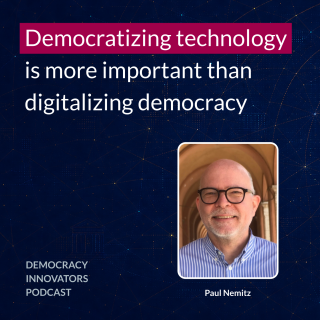
Alessandro Oppo: Yes. I would say, the challenge is to democratize
Alessandro Oppo: the digital and democratize
Alessandro Oppo: the AI
Alessandro Oppo: rather than the other way around to digitalize democracy
Alessandro Oppo: and, you know, make democracy
Alessandro Oppo: the object of AI
Alessandro Oppo: consensus finding or or whatever.
Alessandro Oppo: So let's
Alessandro Oppo: work
Alessandro Oppo: together to democratize
Alessandro Oppo: AI,
Alessandro Oppo: to decentralize
Alessandro Oppo: AI as a technology. Let's develop,
Alessandro Oppo: and I call on you because I can't develop, I call on people who have the technological knowledge,
Alessandro Oppo: to develop AI which is decentral,
Alessandro Oppo: which doesn't allow power concentration,
Alessandro Oppo: which spreads
Alessandro Oppo: wealth
Alessandro Oppo: in different countries and different regions,
Alessandro Oppo: and
Alessandro Oppo: which is also
Alessandro Oppo: controlled
Alessandro Oppo: by different entities and, you know, not just by five or six or 10 companies
Alessandro Oppo: in the world. I think that's what we should be aiming for, and I'm happy to hear from time to time that
edge computing
Alessandro Oppo: and maybe also open weight
Alessandro Oppo: AI models may go in this direction.
Alessandro Oppo: Every
Alessandro Oppo: type of decentralization
Alessandro Oppo: of the technology itself
Alessandro Oppo: and of the control of the technology is a step forward and is good for democracy. That's the first point. The second
point is
Alessandro Oppo: democracy
Alessandro Oppo: needs the technological
Alessandro Oppo: knowledge of the new technical intelligentsia,
Alessandro Oppo: the people who work with digital and AI, which develop it, which use it as professionals,
Alessandro Oppo: and so on.
Alessandro Oppo: And I would invite all of you to participate in one
Alessandro Oppo: way or the other through a party, through an NGO,
Alessandro Oppo: through a trade or or or professional organization in democratic dialogue and democratic process.
Alessandro Oppo: That's what our society needs
Alessandro Oppo: also from technologists,
Alessandro Oppo: not just the technology as such.
Paul Nemitz: Thank you a lot, Paul,
Paul Nemitz: and if you'd like to add anything else that maybe we didn't touch.
Alessandro Oppo: Thank you, Alessandro. It was good to talk to you. My pleasure.