
Democracy Innovators Podcast

Democracy Innovators Podcast@podcast

3 followers
Follow

2026 episodes (26)

Malik Lakoubay from Dark Matter Labs on financing civic infrastructure and democratic innovation
Ep. 58

Malik Lakoubay from Dark Matter Labs on financing civic infrastructure and democratic innovation

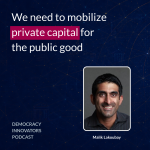
Malik Lakoubay is a system builder and co-runs the Expanding Civilizational Optionality initiative at Dark Matter Labs, working at the intersection of civic infrastructure, finance, technology, and democratic renewal. In this episode, he explores how technology can enable new forms of participation and collective decision-making, from quadratic voting to community sensing in Mumbai. The conversation takes a provocative turn into “civic finance”: treating civic infrastructure as an asset class and exploring democracy bonds as a way to mobilize private capital for public value. Lakoubay also discusses token economics, incentive design, and why democratic innovation may require rethinking how value is created, measured, and shared.

Olivier Schulbaum on democracy after the platform and the struggle for democratic infrastructures
Ep. 57

Olivier Schulbaum on democracy after the platform and the struggle for democratic infrastructures

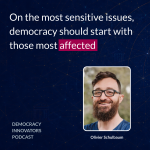
Olivier Schulbaum co-founded Platoniq, a foundation at the intersection of participation, civic technology, culture, social innovation and democratic experimentation. He explains why citizen assemblies on sensitive issues should begin with those most affected, allowing them to shape the agenda before experts frame the question. The conversation also examines how institutional “technification” can drain citizens’ proposals of their original meaning. It then turns to GRID, an experimental AI agent with a legislative-theatre “joker” that interrupts the flow and asks participants to reflect. Rather than treating AI as a frictionless route to consensus, Schulbaum explores technology that deliberately introduces friction into deliberation.

Ryan Koch from the Civic Tech Chat podcast on civic innovation and effective use of AI
Ep. 57

Ryan Koch from the Civic Tech Chat podcast on civic innovation and effective use of AI

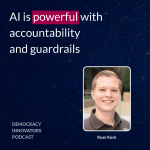
Ryan Koch, host of Civic Tech Chat, joins Alessandro Oppo for a cross-podcast conversation about the evolution of civic tech and the growing role of AI in public-interest technology. They discuss volunteer civic-tech communities, faster prototyping, public data, and the boundaries between civic tech, gov tech, and public-interest tech. The conversation also examines deterministic systems, AI guardrails, explainability, human oversight in public services, the political choices embedded in software, and how technology might support more direct forms of democratic participation.

Gianluca Misuraca from Inspiring Futures on AI in the public sector
Ep. 56

Gianluca Misuraca from Inspiring Futures on AI in the public sector

Gianluca Misuraca of Inspiring Futures Europe, coordinator of the European Union AI Skills Academy, discusses how foresight can help societies shape technological change. He explains why democratic control of AI depends on digital sovereignty, public-sector skills, interoperability, better procurement, and meaningful citizen participation.

 Alvaro Oleart on the instrumentalisation of EU participation processes & limits of AI for democracy
Ep. 55

Alvaro Oleart on the instrumentalisation of EU participation processes & limits of AI for democracy

Alvaro Oleart is an academic researcher based in Brussels at the Université Libre de Bruxelles. His work focuses on social movements, EU participatory practices, democratic innovation, and the political economy of technology. In this conversation, he offers a critical perspective on citizen assemblies, arguing that they can depoliticize democracy when they bypass collective actors such as trade unions, political parties, civil society organizations, and social movements. We also discuss Big Tech, AI, the industry of participation, technology in deliberation, the agentic state, and why democratic innovation should focus more on collective power than on small groups of selected individuals.

Alberto Fernandez Gibaja from International IDEA on Technology and Democracy
Ep. 54

Alberto Fernandez Gibaja from International IDEA on Technology and Democracy

Alberto Fernandez Gibaja leads International IDEA’s global work at the intersection of technology and democracy. In this conversation, he discusses how the early optimism around digital technology changed after Brexit, Trump, and the rise of disinformation, why tech companies can be as powerful as medium-sized countries, and why democratic societies need more control over data, infrastructure, foundation models, and AI applications. We also discuss digital sovereignty, data rights, the limits of direct democracy, political parties, expertise, and why the difficult part of democratic innovation is often political will rather than technology.

Simon Horton on Negotiation, Conflict Resolution, and How AI Can Help End War
Ep. 53

Simon Horton on Negotiation, Conflict Resolution, and How AI Can Help End War

Simon Horton is a negotiation expert, author, and lecturer who has taught negotiation for more than 20 years. In this conversation, he explains why the best negotiators do not treat negotiation as an arm wrestle, but as a collaborative problem-solving process. We discuss political negotiations, peace processes, citizen mediation, and how AI could support better conflict resolution.

Anthony Zacharzewski from Democratic Society on democratic infrastructure, participation and power
Ep. 52

Anthony Zacharzewski from Democratic Society on democratic infrastructure, participation and power

Anthony Zacharzewski is the founder of Democratic Society, an organization working across Europe to build democratic infrastructure and improve participation in government. In this conversation, he discusses how participation can become part of institutional design, why democracy must engage seriously with power, and how digitalization and the agentic state could reshape the relationship between citizens, political parties, and public services.

Alice Casiraghi on designing regenerative systems, public services, and democratic participation
Ep. 51

Alice Casiraghi on designing regenerative systems, public services, and democratic participation

Alice Casiraghi is a systemic designer working on sustainability, circular economy, regenerative systems, and public services. She is a European Climate Pact Ambassador, teaches at Politecnico di Milano and created Climate Cards to educate on environmental impacts. Through her systemic approach, she gives new perspectives on participation of citizens and beyond. In the interview we talked about:

Paolo Spada on participatory budgeting, citizen assemblies, and scaling democratic innovation
Ep. 50

Paolo Spada on participatory budgeting, citizen assemblies, and scaling democratic innovation

Paolo Spada is a political scientist at the University of Southampton working on participatory budgeting, citizen assemblies, and democratic innovation. In this episode, we talk about feedback loops, scaling participation, political parties, online deliberation, and why democratic innovation needs stronger critique as it becomes more established. A central idea in the conversation is that scaling democratic participation is not mainly a technical problem. It is a political problem, and tools like AI only help when ownership, transparency, and accountability remain under democratic control.

Ben Nelson on the Minerva Project, reforming higher education and its role for democracy
Ep. 47

Ben Nelson on the Minerva Project, reforming higher education and its role for democracy

Ben Nelson is founder and CEO of the Minerva Project and founder of the Minerva University. His mission is to reinvent higher education by utilising a systematic and evidence-based approach to learning. Drawing on his extensive entrepreneurial experience and keen awareness of societal issues, he offers valuable insights into the relationship between education and democracy, as well as the steps required to pursue one’s passion and achieve success.

Cecile Green & Seth Frey on the Commoning Standard and the role of self-governance for democracy
Ep. 46

Cecile Green & Seth Frey on the Commoning Standard and the role of self-governance for democracy

Cecile Green is a social entrepreneur and Seth Frey is a computational social scientist. They share a mission to enable healthy self-organization and improve relationships in society, which naturally impacts democracy. Together, they work on the Commoning Standard, which unites stakeholders from research and practice to develop standards for effective self-governance.

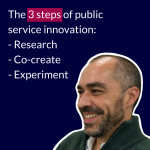
Jorge Lagarto about LabX and human centric design in the public sector
Ep. 44

Jorge Lagarto about LabX and human centric design in the public sector

Jorge Lagarto is director at LabX, a center for public sector innovation. With many years of experience in the field, Jorge provides clear guidance on making services more citizen-friendly by integrating their needs and expectations. We talked about: Public sector innovation and examples with the LabX The 3 steps of public service innovation Workflow re-design vs. technology AI in public service and the agentic state Risks of digitalization

Wietse van Ransbeeck about Go Vocal and how to integrate participation into governance
Ep. 43

Wietse van Ransbeeck about Go Vocal and how to integrate participation into governance

.Wietse van Ransbeeck is the CEO and co-founder of Go Vocal, a leading platform for community engagement. The company partners with over 600 municipalities and cities worldwide to facilitate citizen dialogue and provide governments with insights for better decision-making. If you enjoy our podcast, please consider making a donation. It really helps us to sustain the podcast. PayPal: https://www.paypal.com/ncp/payment/7KCR9XBSCQVMG

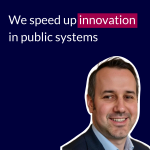
Marcello Coppa on the Feel Community, the Govtech Forum and accelerating innovation
Ep. 42

Marcello Coppa on the Feel Community, the Govtech Forum and accelerating innovation

Marcello Coppa has a background in economics and communications. He has 15 years’ experience in innovation management and consultancy. As the CEO of the Feel Community and curator of the GoVTech Forum, he is working to accelerate innovation in public systems. If you enjoy our podcast, please consider making a donation. It really helps us to sustain the podcast. PayPal: https://www.paypal.com/ncp/payment/7KCR9XBSCQVMG

Stefaan Verhulst about governance, decision-making and how to ask good questions
Ep. 41

Stefaan Verhulst about governance, decision-making and how to ask good questions

.Stefaan Verhulst is Co-Founder of the Governance Laboratory (The GovLab), a research center that is focused on transforming decision making by using advances in science and technology. Stefaan shares a clear view on the most important aspects of governance. If you enjoy our podcast, please consider making a donation. It really helps us to sustain the podcast. PayPal: https://www.paypal.com/ncp/payment/7KCR9XBSCQVMG

Yuting Jiang on the Agora Citizen Network, Polis and bridging-based algorithms
Ep. 40

Yuting Jiang on the Agora Citizen Network, Polis and bridging-based algorithms

Yuting Jiang is CEO and co-founder of the Agora Citizen Network. The Agora tool was inspired by the well-known Polis platform. Yuting understands how modern technologies can improve democratic processes and offers interesting insights into future developments. If you enjoy our podcast, please consider making a donation. It really helps us to sustain the podcast. PayPal: https://www.paypal.com/ncp/payment/7KCR9XBSCQVMG

Nathan Schneider on protocols, modular politics and the governance of online communities
Ep. 38

Nathan Schneider on protocols, modular politics and the governance of online communities

Nathan Schneider is an associate professor of media studies at the University of Colorado Boulder. He has worked for many years on democratic ownership and governance for online platforms, and is currently writing a book about how protocols shape human organization. If you enjoy our podcast, please consider making a donation. It really helps us to sustain the podcast. PayPal: https://www.paypal.com/ncp/payment/7KCR9XBSCQVMG

Matt Stempeck on the Civic Tech Field Guide and why projects succeed or fail
Ep. 37

Matt Stempeck on the Civic Tech Field Guide and why projects succeed or fail

Matt Stempeck is founder and curator of the Civic Tech Field Guide, which lists civic tech projects from all over the world. With 20 years experience in civic tech, Matt has seen projects passing and persisting in this challenging field. He has a profound understanding of what makes a project successful and what makes it fail. If you enjoy our podcast, please consider making a donation. It really helps us to sustain the podcast. PayPal: https://www.paypal.com/ncp/payment/7KCR9XBSCQVMG

Samuel Vance-Law on how digital transformation gives space to governance innovation
Ep. 36

Samuel Vance-Law on how digital transformation gives space to governance innovation

Samuel Vance-Law is Senior Researcher at the Decentralization Research Center and excited about governance and blockchain. He sees technology, especially blockchain, as an opportunity for governance innovation that can serve as a sandbox for progress also in our political democracies. In this episode we talked about: 🤖 Why governance is not sexy 🔢 Governance in DAOs and the blockchain space 📕 How to engage people in democracies ⚙️ Why efficiency is not everything 💰 Why we need to think bigger and weirder 💸 Support us with a donation: https://www.paypal.com/ncp/payment/7KCR9XBSCQVMG

 Cross-podcast dialogue on governance, democracy, and institutional innovation
Ep. 35

Cross-podcast dialogue on governance, democracy, and institutional innovation

In a joint live stream between the Democracy Innovators Podcast and Governance Futures Podcast we wrapped up our learnings from last year and gave a perspective on the next year. We examined the evolving relationship between democratic systems, digitally networked communities, and emerging governance architectures. We summarized the technological developments in Web3 and AI, as well as challenges in democratic deliberation, concluding with the mission to nurture a movement of governance innovation.

Simone Maria Parazzoli about the Agentic State and how algorithms can transform governments
Ep. 34

Simone Maria Parazzoli about the Agentic State and how algorithms can transform governments

Simone Maria Parazzoli is part of the Agentic State project and previously worked for the OECD and the ISI Foundation. His experience on the digital transformation of governments gives interesting insights. In this episode we talked about the Agentic State, an attempt to use technologies, especially AI, to provide governments with better services and faster decisions. If you enjoy our podcast, please consider making a donation. It really helps us to sustain the podcast. PayPal: https://www.paypal.com/ncp/payment/7KCR9XBSCQVMG